
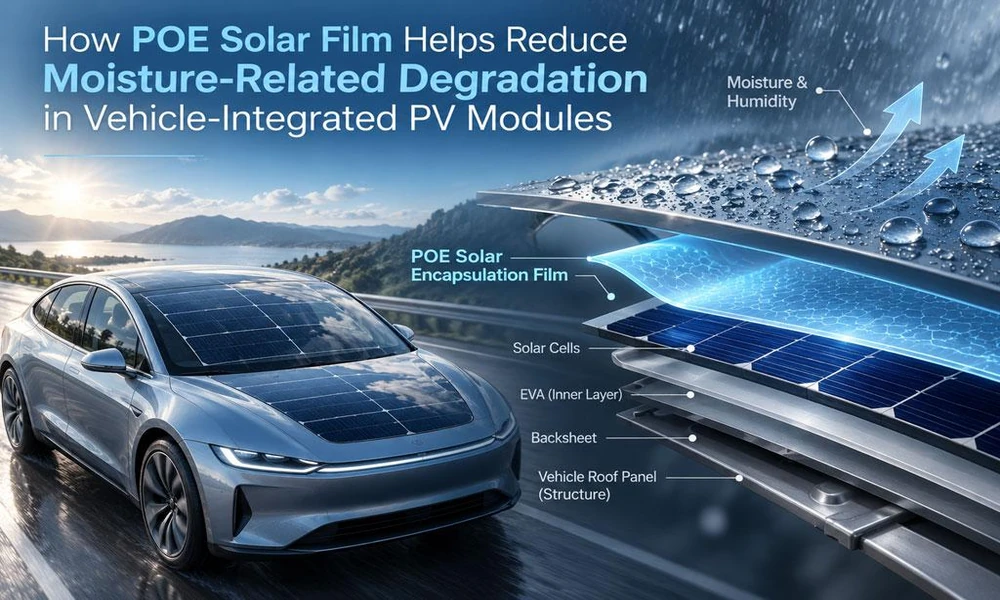
Vehicle-integrated photovoltaics (VIPV) are emerging as a promising technology for generating solar electricity directly from vehicle surfaces. By integrating photovoltaic modules into roofs, hoods, and other body panels, manufacturers can support auxiliary electrical systems and potentially extend electric vehicle driving range.
However, automotive environments create demanding conditions for photovoltaic materials. Frequent temperature changes, rain, humidity, vibration, and mechanical stress can accelerate module degradation. Among these challenges, moisture ingress is particularly concerning because it can cause corrosion, electrical insulation losses, and reduced solar cell performance.
POE solar film offers an effective solution through its low moisture permeability, electrical insulation properties, and resistance to moisture-related chemical degradation.
Why Moisture Protection Matters in Vehicle-Integrated PV
Unlike conventional rooftop solar panels, vehicle-integrated PV modules experience constantly changing environmental conditions.
A vehicle may remain parked under intense sunlight, encounter heavy rainfall, undergo repeated washing, and experience substantial temperature variations within a single day.
These conditions can expose solar modules to moisture through their edges, interfaces, and packaging materials.
Once moisture enters a photovoltaic module, several degradation mechanisms may occur:
- Metal corrosion: Moisture can accelerate corrosion of solar cell electrodes, ribbons, and electrical connections.
- Delamination: Humidity and thermal stress can weaken adhesion between encapsulation layers.
- Electrical leakage: Moisture can increase ionic conductivity and contribute to insulation problems.
- Power degradation: Corrosion and other moisture-induced changes can reduce photovoltaic conversion efficiency.
Research identifies moisture ingress as a major contributor to several photovoltaic module degradation mechanisms.
For automotive applications, preventing these problems is essential for maintaining reliable solar electricity generation throughout the vehicle’s operating life.
1. Low Water Vapor Transmission Reduces Moisture Penetration
One of the most important characteristics of POE solar film is its relatively low water vapor transmission rate (WVTR).
WVTR measures how much water vapor passes through a material under specified testing conditions. Lower values generally indicate stronger resistance to moisture transmission.
Compared with conventional EVA (Ethylene Vinyl Acetate) encapsulation films, appropriately formulated POE films typically provide better moisture barrier performance.
For example, Betterial’s POE B602 solar encapsulation film has a reported WVTR below 5 g/m²·day under its specified test conditions.
By limiting water vapor movement through the encapsulation layer, POE film helps reduce moisture exposure around sensitive photovoltaic components.
This characteristic is particularly beneficial for lightweight vehicle-integrated modules using polymer-based front or rear sheets, where moisture management depends heavily on the complete encapsulation structure.
2. Reducing Corrosion of Solar Cell Metallization
Solar cells contain metallic electrodes, conductive ribbons, and electrical interconnections that are vulnerable to corrosion under humid conditions. Moisture can accelerate electrochemical reactions, increasing electrical resistance and potentially reducing module output.
Traditional EVA encapsulants contain vinyl acetate groups that can undergo hydrolysis under certain environmental conditions, potentially generating acetic acid. This acidic byproduct may contribute to metallization corrosion.
POE encapsulants do not contain the same vinyl acetate chemistry, reducing the risk associated with this specific degradation pathway. Combined with lower moisture permeability, POE provides a favorable environment for protecting solar cell metallization.
However, corrosion resistance also depends on encapsulant additives, manufacturing cleanliness, and component compatibility.
3. Improving Electrical Insulation Under Humid Conditions
Electrical insulation is another critical consideration for vehicle-integrated photovoltaic systems. When moisture accumulates inside solar modules, ionic transport and leakage currents may increase, potentially contributing to electrical degradation.
POE solar films generally offer high volume resistivity and favorable resistance to moisture-assisted ionic transport. These properties can help limit certain potential-induced degradation (PID) mechanisms.
Although automotive PV systems often operate at lower voltages than utility-scale solar installations, reliable insulation remains important for electrical safety and consistent system operation.
POE encapsulation can therefore contribute to improved electrical reliability when combined with appropriate module design and insulation protection.
4. Supporting Adhesion Reliability During Temperature Changes
Vehicle-integrated solar modules frequently experience temperature fluctuations caused by sunlight exposure, ambient conditions, and vehicle operation. Repeated heating and cooling can create mechanical stress between materials with different thermal expansion coefficients. When combined with moisture exposure, these stresses may contribute to interfacial degradation and delamination.
Properly formulated POE films provide flexibility and mechanical cushioning that can help accommodate movement between solar cells and surrounding layers. Nevertheless, POE does not automatically eliminate delamination. Adhesion depends on surface treatment, encapsulant formulation, lamination conditions, and aging performance.
Selecting compatible materials and optimizing the lamination process are therefore essential.
Research on lightweight VIPV modules has highlighted the importance of combining encapsulation design with mechanical and damp-heat reliability testing.
5. Improving Long-Term Reliability of Lightweight Automotive Solar Modules
Automotive manufacturers increasingly explore lightweight and curved photovoltaic structures to improve vehicle integration. These designs may use thin glass, flexible polymer substrates, or alternative packaging configurations.
Although these materials support weight reduction and design flexibility, they may introduce additional moisture protection challenges.
POE solar film can contribute to reliable lightweight module construction by providing moisture resistance, electrical insulation, and mechanical flexibility. However, long-term performance requires comprehensive evaluation of the entire module structure, including edge sealing and barrier layers.
How to Evaluate POE Film for Automotive PV Applications
Before selecting POE encapsulation film, manufacturers should evaluate several important performance characteristics.
| Evaluation parameter | Purpose |
|---|---|
| Water vapor transmission rate | Assess moisture barrier performance |
| Damp heat resistance | Evaluate degradation under elevated humidity and temperature |
| Volume resistivity | Verify electrical insulation performance |
| Peel strength | Assess adhesion durability |
| Thermal cycling resistance | Evaluate performance during repeated temperature changes |
| Mechanical vibration resistance | Verify suitability for vehicle operating conditions |
Testing should include applicable photovoltaic qualification methods, such as IEC 61215-based environmental testing, alongside automotive-specific vibration, impact, and thermal exposure assessments.
